
International Max Planck Research School for Infectious Diseases and Immunology
International Max Planck Research School for Infectious Diseases and Immunology
 Interview Training
Trainer: Prof. Leonie Ringrose
Target group:
Doctoral researchers in their last year /finishing soon
Learning objectives:
Full description:
Please find a detailed description here:
Interview_training_PhD_students
Course fee: 180 € (will be deducted from your yearly course budget)
Date: 2 November, 2026
Trainer: Prof. Leonie Ringrose
Target group: first year doctoral researchers with the aim to put “career” on their horizon from day one
Learning objectives:
After the workshop, participants can:
Full description:
Please find a detailed description here: Career orientation
Course fee: 180 € (will be deducted from your yearly course budge

Date: tbd
Target group: doctoral researchers in all stages, postdoctoral researchers.
Learning objectives:
After the workshop, participants can:
Course fee: tbd
Date: tbd
This intensive workshop about writing a scientific paper involves analysis of good and bad examples from the literature and detailed feedback on writing tasks performed both individually and as teamwork.
Learning objectives:
After the workshop, participants will have:
• Written and received feedback on each section of a paper.
• You will have a “reference toolbox” of structure, syntax and vocabulary for each part of the paper.
• You will also gain skills in speed-reading,
• Fast and effective planning
• Writing scientific English to a fully professional standards.
Course fee: tbd
 Statistical Literacy
Trainer: Dr. Rick Scavetta
Target group:
You are an early-stage researcher or data scientist and want to become statistically literate
You need a refresher to properly understand and use statistics as a part of your scientific inquiry
You’re a business professional and want to improve your skills to better your future career prospects
Course content & trainers profile:
To find in the attachment
Statistical Literacy – Info Sheet
Or on the website:
https://scavetta.academy/statistical-literacy/
Trainer: Dr. Rick Scavetta
Target group:
You are an early-stage researcher or data scientist and want to become statistically literate
You need a refresher to properly understand and use statistics as a part of your scientific inquiry
You’re a business professional and want to improve your skills to better your future career prospects
Course content & trainers profile:
To find in the attachment
Data Analysis with R – Info Sheet
Or on the website:
https://scavtta.academy/statistical-literacy/

Trainer:
Desiree Dickerson, PhD / Dickerson et al.
Short description:
Academia is an ultramarathon that we try to run as a sprint. We quickly run out of time and energy and can experience waning motivation, burnout, and a sense of failure. Although the environment certainly plays a role, we as individuals can address the way we approach academia to buffer us against stress and burnout, worry and fear, and the toxic competition we are often surrounded by. A healthier approach to research is possible!
In this workshop:

First aid for physical illness is the norm in our society—everyone who gets a driver’s license must take a first aid course—but we have yet to establish first aid for mental health problems. This is the aim of Mental Health First Aid, a global program that was created in Australia in 2000, based on the successful model of first aid for physical illness. The program is primarily for laypeople and there are now more than 4 million Mental Health First Aiders worldwide. The knowledge and application of Mental Health First Aid is taught in courses by certified trainers. Participation in a Mental Health First Aid course improves knowledge, reduces stigma, increases confidence in one’s ability to help, and strengthens one’s mental health.
You can find information on training for Mental Health First Aiders here: https://www.zi-mannheim.de/en/patient-care/mhfa-mental-health-first-aid.html

Trainer: Dr. Jernej Zupanc
Target group:
All stages of your PhDs, useful for all who want to visually amplify their messages. No inherent talent is necessary.
Course content:
This comenable you to visually communicate your complex research ideas and findings so your messages are effortlessly understood prehensive communication training will by any target audience (scientists or non-scientists). You will learn a strategic design process that is aligned with how humans easily interpret visual information and can be applied to create effective scientific images, posters, and slides. This is an immersive training, structured, easy to follow, memorable, useful, and fun.
Please check here for the course content.
More information about the trainer and course content:


 The idea:
Learn more about the 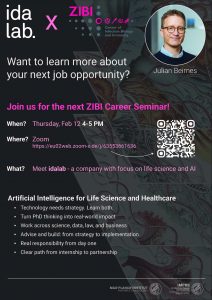 different paths & jobs after your PhD and start a network. This series lives from your own engagement. It’s not necessarily required that you have already people in your network. You can propose people or if required, we can also help with potential ideas or contacts of speakers if you give us an idea of the field / people you like to invite.
How it works:
1-2 doctoral students per session invite and host a speaker each (each speaker 25min talks+questions). Speaker can be any person that did a PhD in the (ideally biological) sciences who left academia at some point and work now in different fields of interest.
The format is indeed relaxed, speakers should describe how they got where they are right now, their motivations, trepidations, successes or failures on the way. And any recommendations or tips of course of how to get or what to do/not to do and when in the career to get to the position they are in right now.